



Naked Nutrition vs Plant-Based Competitors: 2026 Guide
Table of Contents
- Naked Nutrition vs Plant-Based Competitors: The Short Answer
- Protein Source and Blend Composition
- Protein Per Serving and Amino-Acid Completeness
- What Makes the Best Vegan Protein Powder for Recovery
- Defining a Clean Plant-Based Protein Powder
- Plant-Based Protein Powder Taste Test: Texture and Mixability
- Vegan Protein Powder Price Per Serving Compared
- Third-Party Testing, Allergens, and Label Claims
- Where Naked Nutrition Wins and Where It Falls Short
- Frequently Asked Questions
Last Updated: October 21, 2026
Naked Nutrition vs Plant-Based Competitors: The Short Answer
Naked Nutrition built its reputation on short ingredient lists, and the naked nutrition vs plant based competitors question comes down to whether that minimalism is worth the trade-offs. Our verdict: Naked Nutrition is a solid choice if you want unflavored, single-source protein and nothing else. If you want a complete amino-acid profile, a shake that actually tastes good, and digestive support built in, a formulated blend wins. This guide from VitaFaze breaks down protein source, amino-acid completeness, taste, texture, and cost per serving so you can pick with your eyes open.
The phrase "clean protein" gets thrown around loosely. We define it as a short, recognizable ingredient list, no artificial colors or sweeteners, and a stated protein source you can trace. That definition matters because it separates marketing from label math.
Below, we compare these powders on the criteria that actually affect recovery: protein source, amino-acid profile, added sugar, mixability, and cost per serving. Here is what most roundups get wrong: they rank by brand recognition instead of grams of protein per dollar.
How We Compared These Powders
We scored every powder on five criteria: protein source and blend composition, grams of protein per serving, amino-acid completeness, ingredient transparency, and cost per serving. Taste and texture came next, since a powder you dread drinking rarely gets used.
No single powder wins on all five. Single-source options like pea or rice protein tend to score well on transparency and poorly on amino-acid completeness. Blends score the reverse. Our scoring weights amino-acid completeness and cost per serving highest, because those two factors drive recovery and long-term value.
| Criterion | What We Measured | Why It Matters |
|---|---|---|
| Protein source | Single vs. blend, plant type | Determines amino-acid coverage |
| Protein per serving | Grams per scoop | Affects dosing and cost |
| Amino-acid profile | Completeness of essential amino acids | Drives muscle repair |
| Ingredient transparency | Label length, additive count | Predicts digestive comfort |
| Cost per serving | Price divided by servings | Reveals real value |
Protein Source and Blend Composition
Plant-based protein powders fall into two camps: single-source and blended. Single-source powders use one plant, usually pea, rice, hemp, or soy. Blended powders combine two or more sources to cover each other's amino-acid gaps.
Naked Nutrition leans toward single-source simplicity. Its plant proteins are typically pea or brown rice based, with few added ingredients. That is a real advantage if you have sensitivities and want to isolate one variable.
The trade-off is coverage. Pea protein is low in methionine. Rice protein is low in lysine. Hemp protein is low in lysine and leucine. Soy and chia are closer to complete on their own. A blend of pea and brown rice solves this by combining complementary profiles.
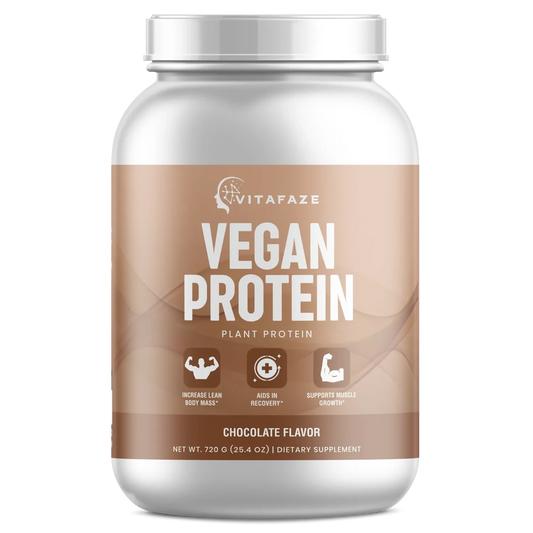
VitaFaze's Vegan Protein Chocolate Shake uses organic pea protein and organic brown rice protein together, which is the classic complementary pairing. That combination gives you a more well-rounded amino-acid profile than either source alone.

A common mistake is assuming "plant-based" means "complete." It does not. Check the source before you assume the profile.
Protein Per Serving and Amino-Acid Completeness
Grams per serving tell you how much protein you get. Amino-acid completeness tells you how much of it your body can actually use for muscle repair. Both numbers matter, and most labels only make the first one easy to find.
A complete protein contains all nine essential amino acids in adequate amounts. Soy, quinoa, and buckwheat are complete on their own. Pea, rice, hemp, and most nuts are not. Combining a legume with a grain covers the gaps.
VitaFaze's Vegan Protein Chocolate Shake delivers 22 grams of complete plant-based protein per scoop from that pea-and-rice blend. The Essential Meal Replacement line goes higher at 24 grams per serving across seven protein sources, which spreads the amino-acid load across more inputs.

Here is the practical rule we use: if a powder lists one plant source and no complementary grain, treat it as incomplete and pair it with a grain at the same meal. If it lists two or more complementary sources, you can stop worrying about the profile.
What Makes the Best Vegan Protein Powder for Recovery
The best vegan protein powder for recovery delivers three things: enough total protein per serving, a complete essential amino-acid profile, and ingredients your gut tolerates. Miss any one of those and recovery suffers, no matter how clean the label looks.
Recovery depends on leucine. Research on protein quality, including work summarized by the National Institutes of Health on dietary protein, consistently points to leucine as the key trigger for muscle protein synthesis. Plant proteins are generally lower in leucine than whey, which is why blends and higher doses matter for plant-based athletes.
Digestibility is the second lever. Plant proteins often carry fiber and antinutrients that slow absorption. Powders that add digestive enzymes or use isolated sources reduce that friction. VitaFaze's meal replacement shakes include digestive enzymes alongside 5 grams of fiber, which supports absorption rather than fighting it.
Vegan Protein Chocolate Shake - 1.5lb Pure Plant-Based Nutrition for Optimal →

The third lever is consistency. A powder you actually drink daily beats a theoretically superior one sitting in the cupboard. That is where taste and texture stop being cosmetic and start being performance variables.
Defining a Clean Plant-Based Protein Powder
A clean plant-based protein powder is one with a short, recognizable ingredient list, no artificial colors or sweeteners, a stated plant protein source, and no proprietary blends hiding the doses. Everything beyond that is marketing.
We apply four tests. First, count the ingredients. Under ten is clean; over twenty needs scrutiny. Second, check the sweetener. Organic stevia and erythritol are common clean choices; sucralose and acesulfame potassium are not. Third, look for "natural flavor" without a source, which is a loophole, not a guarantee. Fourth, confirm whether the powder is third-party tested.
VitaFaze's Vegan Protein Chocolate Shake passes all four: organic pea and rice protein, organic chocolate flavor and cocoa powder, sweetened with organic erythritol and organic stevia, and 3 grams of sugar per serving at 140 calories. The Organic Super Greens line is produced in an FDA-registered facility with GMP certification and third-party tested ingredients.
Plant-Based Protein Powder Taste Test: Texture and Mixability
Texture and mixability separate powders you keep from powders you abandon. Single-source pea and rice proteins tend to be grittier and chalkier than blends, and unflavored versions taste like what they are: ground legumes.

Chocolate and vanilla mask off-notes best. Unflavored powders are the hardest to drink straight and work best blended into smoothies or oatmeal. Hemp protein brings a distinctly earthy, green taste that no amount of cocoa fully hides.
Mixability depends on the protein isolate and the gums. Powders with acacia gum or similar stabilizers disperse more evenly and resist clumping. VitaFaze's Vegan Protein Chocolate Shake includes organic acacia gum, which supports a smoother texture in a shaker without a blender.
Our practical test: shake 30 grams in 250 milliliters of water for ten seconds and check for clumps at the bottom. If you need a blender every time, the powder will not survive a busy week.
Vegan Protein Powder Price Per Serving Compared
Tub price is a decoy. The number that tells you what you are actually paying for is cost per serving, and the number that tells you whether you are paying for protein or for filler is cost per gram of protein. Most roundups stop at the sticker price. We do the division for you.
The formula is simple: divide the tub price by the servings-per-container line on the back panel, then divide that result by the grams of protein per scoop. That second number is the one that lets you compare a 22-gram scoop against a 24-gram scoop honestly, and it is the number brands rarely put in front of you.
Here is the math on the VitaFaze lineup, using the listed tub prices and label protein counts:
| Product | Tub Price | Cost Per Serving | Cost Per Gram of Protein |
|---|---|---|---|
| Vegan Protein Chocolate Shake | $32.97 | Depends on servings per tub, check the label | Divide cost per serving by 22 |
| Essential Meal Replacement, Chocolate | $33.32 | Depends on servings per tub, check the label | Divide cost per serving by 24 |
| Essential Meal Replacement, Vanilla | $33.32 | Depends on servings per tub, check the label | Divide cost per serving by 24 |
| Organic Super Greens, Watermelon | $47.98 | Not comparable, micronutrient product |
Two things jump out. First, the meal replacement tubs are larger (2.9 pounds versus 1.5 pounds), so even at a nearly identical sticker price they carry more servings and pull the per-serving cost down. Second, the greens product is not a protein powder and should never be entered into a cost-per-gram comparison, mixing categories is how shoppers get fooled into thinking a $47.98 tub is expensive when it is simply a different product.
Normalizing Across Brands and Retailers
When you compare Naked Nutrition against plant-based competitors, do not compare tub to tub. A 1-pound tub and a 2-pound tub are not the same purchase. Normalize in this order:
- Servings per container. This is the divisor for everything else. A larger tub with a smaller scoop can carry fewer servings than a smaller tub with a larger scoop.
- Grams per serving. A 25-gram scoop of a 70% protein powder delivers about 17.5 grams of protein. A 30-gram scoop of an 80% isolate delivers about 24 grams. The scoop size is not the dose.
- Cost per gram of protein. This is the only figure that survives cross-brand comparison, because it strips out scoop-size games and serving-count tricks.
- Shipping and subscription terms. A lower per-serving price with paid shipping can lose to a slightly higher price with free shipping. Check the threshold before you commit.
A common pattern is that single-source, unflavored powders post a lower sticker price but a higher cost per gram of complete protein, because you have to pair them with a complementary source at the same meal to close the amino-acid gap. That second purchase rarely shows up in the comparison table. If you are buying pea protein and rice protein separately to build a complete profile, add both tubs together before you declare the single-source route cheaper.
What the Price Does Not Tell You
Cost per gram of protein is the honest starting point, not the finish line. A cheaper powder you use half as often costs more per effective dose. A powder that clumps and gets abandoned costs infinitely more per serving than one you finish. And a powder with no third-party testing carries a verification cost you cannot see on the label.
Use the per-gram figure to narrow the field to two or three candidates, then decide on amino-acid completeness, mixability, and testing documentation. Price gets you into the comparison. Formulation decides it.
Third-Party Testing, Allergens, and Label Claims
"Third-party tested" is one of the most repeated and least explained phrases in the protein powder aisle. It can mean a lab checked protein content, or it can mean a lab checked for heavy metals, or it can mean a brand paid for a logo. Those are not the same thing, and the difference matters most for plant proteins, where crops like rice and cocoa can carry trace heavy metals from soil.
What Third-Party Testing Actually Covers
Independent verification typically falls into four buckets, and a brand may test for one, some, or all of them:
Vegan Protein Chocolate Shake - 1.5lb Pure Plant-Based Nutrition for Optimal →
- Label accuracy. Does the tub actually contain the protein grams, calories, and sugar the label claims? This is the most basic check and the one most often skipped.
- Heavy metals. Plant proteins concentrate minerals from soil, and rice, cocoa, and some pea sources can carry trace lead, cadmium, or arsenic. Testing tells you whether levels fall below established thresholds.
- Contaminants and microbes. Testing for mold, bacteria, and residual solvents matters more for products with added flavors and botanicals.
- Allergen cross-contact. A lab can verify whether a product labeled gluten-free or soy-free actually is, which is different from the brand simply asserting it.
A brand statement like "made with third-party tested ingredients" is not the same as "this finished product was tested by an independent lab and the certificate is available." The first describes inputs. The second describes the tub in your hand. Ask which one you are getting.
How to Verify a Testing Claim
Verification is a five-minute exercise, and a brand that cannot survive it is telling you something.
- Look for a certificate of analysis (COA). A COA is the lab report. Some brands post them by lot number on their website. If a brand claims testing but will not share a COA, treat the claim as unverified.
- Check who did the testing. An independent lab with no financial relationship to the brand is the standard. In-house testing is useful for quality control but is not third-party verification.
- Match the certificate to the product. A COA for a different SKU or an older lot does not verify the tub you are buying.
- Read the claim language carefully. "Tested" and "certified" are different words with different evidentiary weight.
VitaFaze states that its Organic Super Greens are made with third-party tested ingredients in an FDA-registered, GMP-certified facility. That is a documentation standard worth checking against the COA process above before you treat it as equivalent to finished-product certification. The FDA's guidance on dietary supplement labeling sets out what manufacturers must disclose on the label, and it is worth reading before you trust a front-of-pack claim.
Allergens and Cross-Contact: What the Label Does Not Say
Pea and rice proteins are generally lower-allergen than soy, but the real risk for shoppers with severe allergies is shared facilities. A product can be made from hypoallergenic ingredients and still carry trace soy, wheat, or tree nut residue if it runs on the same line.
Read the label in this order:
- Contains statement. Federal labeling rules require major allergens to be declared (the FDA). If it is not in the Contains line, it should not be an intended ingredient.
- "May contain" or "produced in a facility" language. This is voluntary disclosure, not a guarantee. Its absence does not mean the facility is allergen-free.
- Shared-equipment notes. Some brands disclose shared lines; many do not. If you have a severe allergy, contact the manufacturer directly and ask for the specific line and cleaning protocol rather than relying on the label alone.
For plant-based shoppers, the practical hierarchy is: soy is a declared major allergen and the easiest to avoid by reading the Contains line; gluten cross-contact in oat- and rice-based products is the most common hidden risk; and tree nut cross-contact depends almost entirely on facility disclosure. If a brand will not answer a direct allergen question, that is your answer.
The Verification Standard We Apply
A clean-label claim should come with three documents: a finished-product COA from an independent lab, a full allergen disclosure including facility cross-contact, and specific claim language that can be checked rather than vague language that cannot. Naked Nutrition's transparency play is real on the ingredient list, but ingredient count is not the same as verification. When you compare brands, put the testing documentation next to the ingredient list and see which one is actually doing the work.
Where Naked Nutrition Wins and Where It Falls Short
Naked Nutrition wins on simplicity. Short ingredient lists, single-source proteins, and unflavored options make it easy to know exactly what you are drinking. If you want to isolate one protein source or avoid sweeteners entirely, it is a reasonable pick.
It falls short on completeness and experience. Single-source pea or rice protein leaves amino-acid gaps you have to fill elsewhere. Unflavored powders are hard to drink consistently. And the minimalism means no digestive enzymes and no built-in flavor system.
VitaFaze takes the opposite approach: complementary pea-and-rice blends for a complete profile, real chocolate and vanilla flavors, and digestive support in the meal replacement line. For plant-based athletes who train hard and need recovery to be reliable, that formulation does more work per scoop.
The honest summary: Naked Nutrition is a transparency play. VitaFaze is a performance play. Pick based on which problem you are actually solving.
Plant-based training puts real demands on recovery, and the powder you choose should carry its weight. VitaFaze builds plant-powered nutrition around complete protein blends, clean ingredients, and digestive support, with formulas designed for athletes who train hard and recover harder. Explore the Vegan Protein Chocolate Shake for 22 grams of complete plant-based protein per serving, or the Essential Meal Replacement line for 24 grams with zero added sugar.
Frequently Asked Questions
What is the healthiest cleanest vegan protein powder?
There is no single winner, but the cleanest options share four traits: a short ingredient list, no artificial sweeteners or colors, third-party testing, and a complete amino-acid profile. Look for a blend of pea and rice protein rather than a single source, since that combination covers the essential amino acids your body cannot make on its own. Check the nutrition facts for added sugar and the ingredient list for gums or fillers you do not recognize. A powder with 20 to 24 grams of protein and under 4 grams of sugar per serving is a reasonable benchmark.
How does Naked Nutrition plant protein compare with other vegan protein powders?
Naked Nutrition built its reputation on short ingredient lists and single-source proteins, which appeals to buyers who want to know exactly what they are drinking. That simplicity is a real strength, but it also means fewer flavor options and a texture that some drinkers find chalky compared with blends that add gums or enzymes. Competitors often win on mixability and taste while carrying longer labels. The right pick depends on whether you prioritize a minimal ingredient list or a smoother drinking experience.
What should I look for in a plant-based protein powder?
Start with protein per serving, then read the ingredient list and the nutrition facts side by side. A complete protein combines sources so the amino-acid profile covers all nine essential amino acids. Check for third-party testing, allergen statements, and whether the sweetener is natural or artificial. Finally, calculate price per serving rather than price per tub, because serving sizes vary widely between brands. A powder that costs more per tub can still be cheaper per gram of protein.
How do I compare protein, ingredients, and price per serving?
Divide the tub price by the number of servings per container to get cost per serving, then divide again by grams of protein per serving to get cost per gram of protein. That second number is the fairest comparison because it accounts for both price and protein density. Read the ingredient list for protein source, sweetener, and any gums or enzymes. A powder with 24 grams of protein at a slightly higher serving price can beat a cheaper tub with only 15 grams per scoop.
Which plant protein powders taste best?
Taste is personal, but a few patterns hold across most reviews. Chocolate flavors hide the earthy notes of pea and hemp protein better than vanilla, which is why chocolate is usually the safest first purchase. Blends with digestive enzymes and gums tend to mix smoother and feel less gritty. Single-source powders without those additions often taste more natural but chalkier. If you are switching brands, buy the smallest tub first and test it in water before committing to a larger size.