



Are Plant Based Supplements Effective? A 2026 Guide
Table of Contents
- Are Plant Based Supplements Effective? What the Evidence Shows
- Plant-Based Supplement Bioavailability: Why Form Matters More Than Dose
- Are Plant-Based Vitamins Better for You Than Synthetic Ones?
- Vegan Supplements for Nutrient Deficiencies: What to Address First
- Third-Party Testing and Certification: How to Spot a Real Label
- Best Vegan Supplements for Athletes: Recovery, Endurance, and Energy
- Medication Interactions and Safety: What to Check Before You Stack
- Conclusion: Matching the Right Formula to Your Training
- Frequently Asked Questions
Last Updated: October 5, 2026
Are Plant Based Supplements Effective? What the Evidence Shows
Are plant based supplements effective? Yes, when the formula delivers nutrients your body can actually absorb. A capsule full of plant material means nothing if it passes through you unabsorbed. This guide explains what separates a supplement that works from one that just looks good on a label.
Plant-based supplements are dietary products whose active nutrients come from plant sources rather than laboratory synthesis. That distinction matters less than most people think. What matters is the delivery form, the dose, and whether the finished product has been tested by someone other than the company selling it.
Here's the part most guides skip: absorption is the whole game. Below, we break down bioavailability, third-party testing, dosage by training load, and the three nutrient gaps that matter most for anyone eating plant-based.
Why Absorption Determines Whether a Supplement Works
Bioavailability is the proportion of a nutrient that reaches your bloodstream in a form your body can use. A label can claim 500 mg of a nutrient and still deliver a fraction of it if the source is poorly absorbed. This is why form beats dose almost every time.
Vitamin C from whole-food sources like amla comes packaged with co-botanicals that support uptake. Our Plant - Source Vitamin C pairs organic amla with rose hips, hesperidin, and quercetin for exactly this reason. The nutrient isn't floating alone; it arrives with the compounds that help your body use it.

A common mistake is chasing the highest milligram count on the shelf. That number tells you what went into the capsule, not what your cells will see.
Plant-Based Supplement Bioavailability: Why Form Matters More Than Dose
Form determines absorption rate, and absorption rate determines whether a supplement does anything at all. Two products can list identical nutrients and perform completely differently based on how those nutrients are bound.
Chelated minerals, where the mineral is attached to an amino acid, generally absorb better than oxide forms. Whole-food matrices, where nutrients arrive alongside the plant's natural co-factors, tend to outperform isolated compounds. The NIH Office of Dietary Supplements fact sheets outline how nutrient form affects absorption for several key vitamins and minerals.
Absorption Kinetics: How Fast Nutrients Enter Your Bloodstream
Absorption kinetics describes how quickly and how completely a nutrient moves from your gut into circulation. Water-soluble vitamins like B12 and vitamin C typically peak within a few hours. Fat-soluble vitamins and minerals follow slower curves and depend heavily on what else is in your stomach.
Why does the timing matter? Because athletes dose around training. A nutrient that peaks four hours after you take it won't help a session that starts in 30 minutes. Matching the absorption curve to your schedule is a real variable, and almost nobody talks about it.
| Nutrient Type | Typical Absorption Window | Best Taken |
|---|---|---|
| Water-soluble vitamins | 1-3 hours | With water, before training |
| Fat-soluble vitamins | 3-6 hours | With a meal containing fat |
| Chelated minerals | 2-4 hours | Away from high-fiber meals |
| Whole-food antioxidants | Varies by matrix | With food |
Are Plant-Based Vitamins Better for You Than Synthetic Ones?
Not automatically. "Plant-based" describes the source, not the quality. A poorly made plant-based vitamin can underperform a well-formulated synthetic one. The advantage of plant-derived nutrients usually comes from the co-factors that travel with them, not from the plant source itself.
Synthetic vitamin C is chemically identical to the ascorbic acid in an orange. Where plant-derived formulas pull ahead is in the supporting compounds: flavonoids, polyphenols, and trace minerals that come along for the ride. Those extras can improve how well the nutrient works and how long it stays active in your body.
So the honest answer is: it depends on the formula. Look for organic sourcing, transparent labeling, and evidence that the manufacturer tested the finished product.
Vegan Protein Chocolate Shake - 1.5lb Pure Plant-Based Nutrition for Optimal →
Vegan Supplements for Nutrient Deficiencies: What to Address First
B12, vitamin D, iron, and, for many people, iodine and zinc top the list for anyone eating plant-based. These are the gaps that show up most often in practice, and each one has a specific form, dose range, and timing rule that determines whether the supplement actually closes the gap.
The most useful first step is not buying anything. It is testing. Ask your physician to run a basic panel: serum B12 (and methylmalonic acid if B12 is borderline), 25-hydroxyvitamin D, a complete blood count with ferritin, and a thyroid panel if you eat little to no iodized salt or seaweed. You cannot dose what you have not measured, and guessing leads to either wasted money or a deficiency that quietly deepens.
B12, Iron, and Vitamin D: The Three Gaps That Matter Most
Vitamin B12 is the one nutrient you cannot reliably get from unfortified plant foods. It supports nerve function, red blood cell formation, and DNA synthesis, and deficiency develops slowly and quietly, sometimes over years, because the liver stores a reserve. Methylcobalamin and cyanocobalamin are the two common supplemental forms, and both work when taken consistently. Cyanocobalamin is the more stable and better-studied form; methylcobalamin is often marketed as "natural" but has no proven absorption advantage for most people. Typical maintenance dosing falls in the 25-100 mcg per day range for adults, while anyone with a diagnosed deficiency is usually managed at higher doses under medical supervision. Sublingual and chewable forms exist because absorption of B12 depends on intrinsic factor, a protein some people produce less of with age or with certain medications.
Iron from plants is non-heme iron, which absorbs at a fraction of the rate of the heme iron in meat. Pairing plant iron with vitamin C improves uptake significantly, which is why a combined approach works better than iron alone. Just as important: separate iron from coffee, tea, calcium, and high-dose zinc, all of which compete for the same absorption pathways. Ferrous sulfate is the common low-cost form; ferrous bisglycinate is gentler on the stomach and often better tolerated. Do not supplement iron without a ferritin test, excess iron is harmful, and men and postmenopausal women rarely need it.
Vitamin D comes mostly from sun exposure, and levels drop in winter or for anyone training indoors. It plays a role in bone mineral density, immune function, and calcium regulation. Vitamin D3 (cholecalciferol) raises blood levels more effectively than D2 (ergocalciferol), and because it is fat-soluble, it absorbs best with a meal containing fat. Typical maintenance dosing for adults runs 1,000-2,000 IU per day, with higher short-term doses reserved for correcting a documented deficiency under a physician's guidance.
Iodine and zinc round out the list. Iodine supports thyroid function, and plant-based eaters who avoid iodized salt and seaweed can fall short. Zinc from plant foods is bound by phytates, which reduce absorption, so a zinc supplement taken away from high-phytate meals is more effective.
A USDA FoodData Central database is a practical way to check where your current intake actually stands before you add anything. Log a typical week, then compare it against the gaps above.
Third-Party Testing and Certification: How to Spot a Real Label
Third-party testing means an outside lab verifies what's in the bottle, not the company that made it. This is the single fastest way to separate a serious supplement brand from a marketing operation. Certifications like GMP, NSF, and USP each verify different things, and the label should tell you which one applies.
Here's what to check on any product you're considering:
- Does the label name the specific certification body?
- Is the facility registered and inspected?
- Are ingredient amounts listed per serving, not per "proprietary blend"?
- Is there a batch or lot number you could trace if needed?
Our Organic Super Greens - Watermelon is third-party tested and produced in an FDA-registered, GMP-certified facility. That's the standard to hold every brand to, including ours.

Best Vegan Supplements for Athletes: Recovery, Endurance, and Energy
The best vegan supplements for athletes target three things: muscle protein synthesis, recovery speed, and cellular energy. Everything else is secondary. Training breaks you down; the right formula helps you rebuild faster and go again sooner.
Non-heme iron, zinc, and protein from plant sources all absorb less efficiently, which means the effective dose is often higher, and the timing matters more. The framework below accounts for that.

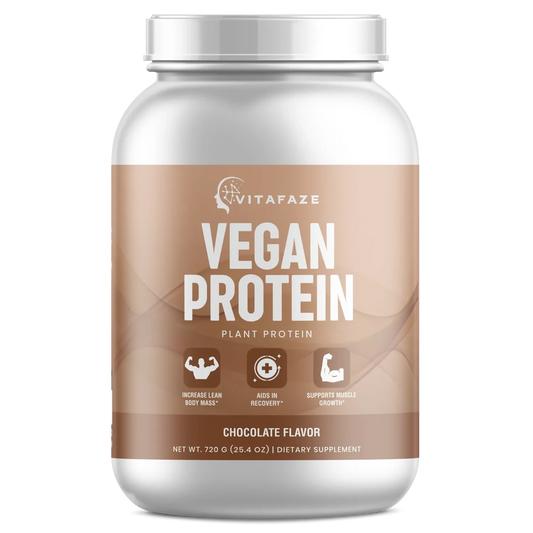
Protein leads the list. A complete amino acid profile supports muscle repair, and plant sources need careful blending to hit that profile. Leucine is the trigger for muscle protein synthesis, and plant proteins are typically lower in it than whey, which is why blends of pea and rice, or pea and soy, outperform single-source plant proteins. Our Vegan Protein Chocolate Shake combines organic pea protein and organic brown rice protein for 22 grams of complete protein per scoop, with 4 grams of fiber and only 3 grams of sugar.
Vegan Protein Chocolate Shake - 1.5lb Pure Plant-Based Nutrition for Optimal →

For endurance and blood flow, Organic Beetroot supports nitric oxide production, which helps circulation and oxygen delivery during longer efforts. Beetroot's dietary nitrates convert to nitric oxide, and the effect is most noticeable in efforts lasting several minutes or longer. Distance runners and cyclists often notice this more than lifters do. Timing matters here too: nitrates typically peak in the blood a few hours after intake, so dosing 2-3 hours before an event is more useful than taking it right at the starting line.
Dosage Optimization by Age and Training Load
Dosage is not one-size-fits-all. A 25-year-old training six days a week has different needs than a 55-year-old training three times a week. Age slows protein synthesis and changes how efficiently you absorb micronutrients, so older athletes generally need more protein per meal to trigger the same repair response, a pattern researchers sometimes call anabolic resistance.
Training load matters just as much. Higher volume raises your demand for protein, iron, and B vitamins. Recovery weeks lower it. A practical framework, stated as ranges rather than fixed numbers because individual needs vary:
- 3-4 sessions per week: baseline protein (roughly 1.2-1.6 g per kg of body weight per day), standard micronutrient coverage
- 5-6 sessions per week: higher protein (roughly 1.6-2.0 g per kg per day), add beetroot for endurance support, watch iron and B12 if you menstruate
- Competition blocks: prioritize recovery timing over total volume, protein within a couple of hours after training, carbohydrates to replenish glycogen, and beetroot 2-3 hours before key efforts
- Athletes over 50: shift protein toward the higher end of the range and spread it across 3-4 meals rather than one large dose, because the per-meal synthesis response is blunted with age
A common mistake is keeping the same dose year-round regardless of what your training actually looks like. Another is treating plant protein as interchangeable with whey gram-for-gram, the leucine content and absorption curve differ, so the effective dose is often higher.
Medication Interactions and Safety: What to Check Before You Stack
Supplements can interact with prescription medications, and plant-based products are no exception. Vitamin K can interfere with blood thinners. High-dose vitamin C can affect certain medications. Beetroot's effect on blood pressure matters if you're already on antihypertensives.
Before you add anything to your routine, run it past your physician or pharmacist, especially if you take daily medication. Bring the actual label, not a memory of it.
One more thing worth checking: quality varies wildly across the category. Independent testing has repeatedly found products whose contents don't match their labels, which is why certification is not optional if you care about what you're actually swallowing.
Conclusion: Matching the Right Formula to Your Training
Getting plant-based nutrition right takes more than picking a protein powder off a shelf. It takes formulas built for absorption, tested by outside labs, and dosed for the way you actually train.
VitaFaze builds plant-powered nutrition around clean, bioavailable ingredients, with targeted support for muscle recovery, endurance, and cellular energy. Our protein shake, beetroot capsules, and vitamin C formula each address a specific gap that plant-based athletes run into. Get started with VitaFaze and give your training the recovery support it has been missing.
Frequently Asked Questions
Are plant-based supplements as effective as non-plant-based supplements?
They can be, but effectiveness depends on formulation rather than origin. Plant-derived nutrients often arrive with co-factors that support absorption, while some synthetic forms absorb faster on an empty stomach. The deciding factor is whether the label states a bioavailable form and a dose backed by clinical evidence. For athletes, a vegan protein with a complete amino acid profile and 20-25 grams per serving supports muscle protein synthesis comparably to whey when total daily protein is matched.
How can you tell whether a plant-based supplement is effective?
Look for three signals: a stated dose per serving, a bioavailable form (such as chelated minerals or methylated B12), and third-party testing documentation. Then track outcomes over 4-8 weeks: recovery time, soreness duration, energy during sessions, and bloodwork for deficiencies like B12 or iron. If nothing changes and the label hides its doses behind a proprietary blend, the formula is likely underdosed rather than ineffective by nature.
Which nutrients may vegans need to supplement?
Vitamin B12 is non-negotiable because it occurs naturally almost exclusively in animal foods. Iron, zinc, vitamin D, iodine, and omega-3 EPA and DHA are the other common gaps. Iron and zinc from plant sources are less bioavailable due to phytates, so pairing them with vitamin C improves uptake. Vitamin D depends on sun exposure and fortification, so many plant-based eaters need a dedicated supplement, especially in winter months.
Can plant-based supplements help with muscle recovery?
Yes, when protein intake and amino acid profile are adequate. Plant proteins like pea and brown rice combine to deliver a complete amino acid profile, and 20-25 grams post-training supports repair. Ingredients like beetroot, which increases nitric oxide production, may improve blood flow and reduce perceived soreness. The key is consistency: recovery benefits show up when you hit daily protein targets, not from a single shake after one hard session.