




Healthy Alternatives to Sugary Energy Gels
Table of Contents
- Why Runners Are Replacing Sugary Energy Gels
- How Much Carbohydrate You Actually Need Per Hour
- Quick Comparison: Healthy Energy Gel Alternatives
- Energy Gel Alternatives for Runners: Real Food That Works
- Homemade Energy Gel Alternatives You Can Mix in Minutes
- What to Eat During a Long Run: A Practical Fueling Plan
- Low-Sugar Endurance Fuel: What It Is and When to Use It
- Sugar Type, Concentration, and Gut Tolerance
- Pairing Fuel With Hydration and Electrolytes
- Testing New Fuel Before Race Day
- Conclusion: Building Your Own Fueling Strategy
- Frequently Asked Questions
Last Updated: October 12, 2026
Why Runners Are Replacing Sugary Energy Gels
Most runners don't abandon energy gels because they stop working. They abandon them because of what happens after mile 15: the sticky hands, the cloying sweetness, the stomach cramp that ends a race early. Healthy alternatives to sugary energy gels have moved from niche experiment to mainstream strategy, and the reasons are practical rather than ideological.
At VitaFaze, we work with plant-based endurance athletes who want fuel that digests cleanly and supports recovery without a long ingredient list. That's the lens we're using here.
The core issue is simple. A traditional gel delivers a concentrated sugar hit in a small package. That works, until your gut decides it doesn't. Many runners find that concentrated sugar causes nausea or a heavy feeling during long efforts. The fix isn't to stop fueling. It's to change what you fuel with.
Below, we'll show you exactly how to replace gels with real food, homemade mixes, and drink-based carbs, plus how much carbohydrate you actually need per hour and how to test any new fuel before race day.
How Much Carbohydrate You Actually Need Per Hour
Endurance fueling comes down to a number: how many grams of carbohydrate you can absorb and use per hour. Get that right and everything else, from food choice to hydration, falls into place.
General sports nutrition guidance points to roughly 30 to 60 grams of carbohydrate per hour for sessions lasting one to three hours. For longer events, some athletes work toward 60 to 90 grams per hour, often using a mix of glucose and fructose. That's a wide range on purpose. Tolerance varies, and the upper end only works if you train your gut to handle it.
Here's the practical breakdown:
| Session Length | Carbohydrate Target | Fuel Format |
|---|---|---|
| Under 60 minutes | Not usually needed | Water |
| 1-2 hours | 30-60 g/hour | Chews, dried fruit, drink mix |
| 2-3 hours | 60 g/hour | Mixed real food and drink |
| 3+ hours | 60-90 g/hour | Dual-source carbs, tested plan |
A common mistake is treating these numbers as a finish line rather than a starting point. Start at the low end, then add roughly 10 grams per hour every few long runs. Your gut adapts, but slowly.
Quick Comparison: Healthy Energy Gel Alternatives
The best alternative for most runners is a carbohydrate drink mix or homemade gel, because both deliver a precise, repeatable dose. Real food works well too, but portions are harder to control on the move.
Here's how the main options stack up:
| Option | Carb Delivery | Portability | Best For |
|---|---|---|---|
| Dates and raisins | Moderate | High | Easy real-food fuel |
| Honey | Fast | High | Quick top-ups |
| Potato puree | Moderate | Low | Salty cravings |
| Energy chews | Precise | High | Measured dosing |
| Carb drink mix | Precise | Medium | Hydration plus fuel |
| Homemade gel | Precise | Medium | Cost control |
Each has a place. The trick is matching the format to the moment, not picking one and forcing it to work everywhere.
Energy Gel Alternatives for Runners: Real Food That Works
Real food is the most accessible swap, and it's been used far longer than any commercial gel. The trade-off is that real food is bulkier and its carbohydrate content is less exact, so you'll need to do a little math.
Dates and Raisins: The Original Portable Fuel
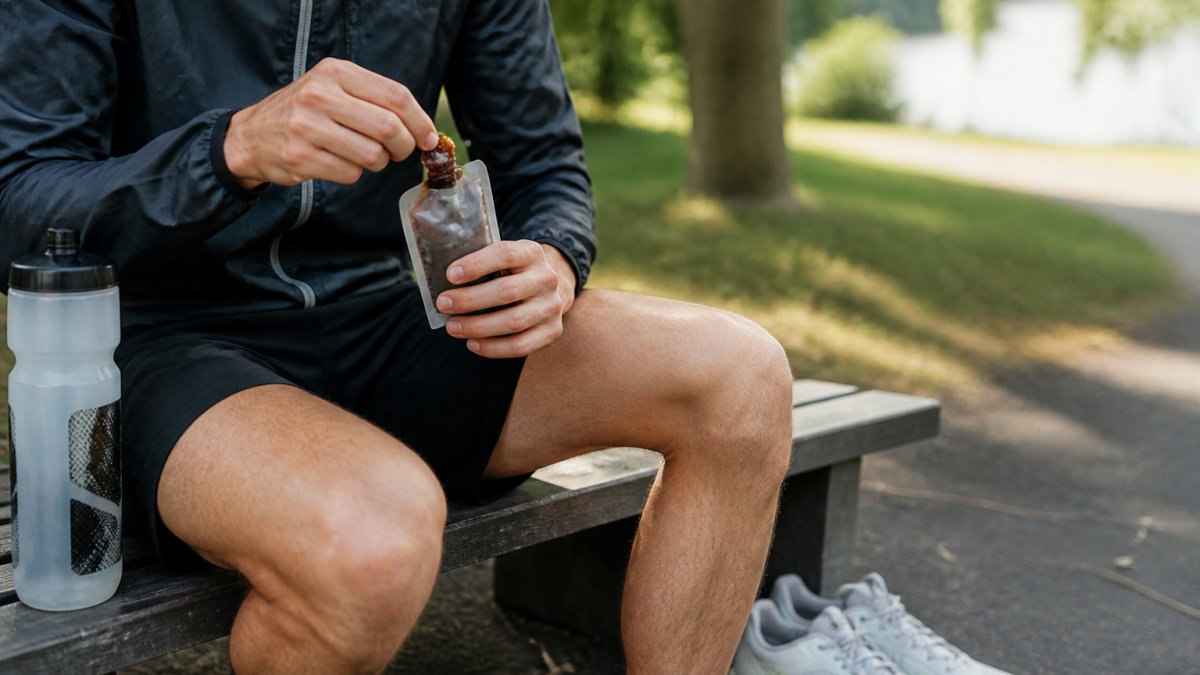
Dates and raisins are among the most practical gel alternatives because they're shelf-stable, cheap, and easy to portion. A small handful of dates delivers a meaningful carbohydrate load, and raisins offer a similar benefit in a smaller, easier-to-chew form.
The catch is fiber. Both are high in it, which slows digestion and can cause discomfort at higher intensities. For easy-paced long runs they're excellent. For race pace, many runners find them harder to manage.
Honey: A Fast, Familiar Carbohydrate Source
Honey is a simple carbohydrate source that's easy to carry in a small squeeze pack. It's roughly two parts glucose to one part fructose, which is close to the dual-source blends used in commercial products.
That ratio matters, and we'll come back to it. For quick energy between aid stations, honey is hard to beat. The downside is that it's still very sweet, so if sweetness is what pushed you off gels, honey may not solve the problem.
Potato Puree and Savory Options for Salty Cravings
Potato puree is the sleeper option in this category. It's a savory carbohydrate source, which is a genuine relief after hours of sweet fuel. Many runners report that salty, starchy foods settle better late in a race than anything sugary.
The practical version: boil potatoes, mash them with a little salt, and carry the puree in a refillable pouch. Add broth for flavor and sodium. It's messy and it doesn't keep as long as packaged fuel, but for a long training run it works well.
Homemade Energy Gel Alternatives You Can Mix in Minutes
Homemade energy gel alternatives give you control over sweetness, thickness, and cost. A basic recipe takes about five minutes and uses ingredients you likely already have.
ION + Select Electrolyte Formula →
A Simple Base Recipe and Flavor Variations
Base recipe (roughly 25 g carbohydrate per serving):
- 2 tablespoons honey or maple syrup
- 1 tablespoon water
- Pinch of salt
- Optional: 1/4 teaspoon lemon juice as a preservative
Method: Whisk everything together until smooth. Funnel into a small refillable pouch or a soft flask. Refrigerate and use within a few days.
Flavor variations:
- Citrus: add a squeeze of orange or lemon
- Salty: increase salt and add a pinch of broth powder
- Berry: stir in a spoonful of fruit puree
- Ginger: add a small amount of grated ginger to settle the stomach
The exact carbohydrate content depends on your sweetener, so measure once and note the number. Consistency is what makes a homemade mix race-ready.
What to Eat During a Long Run: A Practical Fueling Plan
A fueling plan is a schedule, not a menu. Decide what you'll take and when, then rehearse it. Here's a simple structure for a three-hour run.
- Hour 1: Start fueling early. Take 30-40 g of carbohydrate as chews, dates, or drink mix.
- Hour 2: Switch formats to avoid flavor fatigue. Move to a savory option or a different carb source.
- Hour 3: Hold your rate. If you've tolerated 60 g/hour, keep it steady rather than increasing.
- Throughout: Sip fluids with electrolytes alongside your fuel.
The biggest mistake here is waiting until you feel tired to eat. By then you're already behind, and catching up mid-effort is much harder than staying on schedule.
Low-Sugar Endurance Fuel: What It Is and When to Use It
Low-sugar endurance fuel is any carbohydrate source that delivers energy with less concentrated sweetness, often by pairing carbs with electrolytes, fat, or fiber. It's not zero-carb, and it's not a magic fix.
When does it make sense? For easy training runs, low-intensity sessions, and athletes who genuinely can't tolerate sweet fuel. For high-intensity racing, you still need fast carbohydrate, and "low-sugar" can mean "too slow."
The honest limitation: if a product markets itself as low-sugar but delivers the same carbohydrate load, you've changed the taste, not the fuel. Read the label, not the front of the package.
Sugar Type, Concentration, and Gut Tolerance
This is the part most guides skip, and it's where fueling actually succeeds or fails. Not all sugar is the same, and how concentrated it is matters as much as how much you take.
Why sugar type matters: separate doors in the gut
Glucose and fructose don't enter the bloodstream through the same transporter. Glucose rides on one pathway; fructose uses another. Because they don't compete for the same door, combining them lets you absorb more total carbohydrate per hour than either alone. That's the entire logic behind dual-source blends.
A ratio of roughly two parts glucose to one part fructose is the pattern most endurance products use, and it's the ratio most practitioners point to when athletes need to push past about 60 grams per hour. Honey happens to land near that ratio naturally, which is part of why it works as a gel swap. Table sugar (sucrose) is close to a 1:1 split of glucose and fructose once digested, so it behaves differently than pure glucose.
What this means in practice:
- Under ~60 g/hour: a single-source carb (glucose, maltodextrin, or most starches) is usually fine.
- 60-90 g/hour: a mixed glucose-fructose source is the standard approach, because single-source absorption tends to cap out.
- Above 90 g/hour: only worth attempting with a trained gut and a tested plan, this is not a starting point.
Concentration: the lever almost nobody explains
Concentration is the other half of the equation, and it's the one that causes most mid-race stomach problems. The gut absorbs carbohydrate best when the mix is roughly isotonic, close to the concentration of your body fluids. Push past that and the solution pulls water into the intestine instead of releasing it, which is the cramping, sloshing feeling many runners blame on "gels" when the real issue is how concentrated the gel was.
A few practical consequences:
- A thick gel taken alone is a very concentrated sugar hit. Follow it with water, and it dilutes in the stomach.
- A drink mix can be too strong if you scoop heavy or under-fill your bottle. Mix to the label, then adjust.
- A mix that's too weak means you drink an uncomfortable volume to hit your carb target, fine on a cool day, miserable in heat.
Fiber, fat, and protein slow things down
Fiber, fat, and protein all slow gastric emptying. That's not automatically bad, it's why dates and raisins feel steadier than a gel on an easy long run. But at race pace, slow digestion is a liability: the fuel sits in the stomach while your muscles are asking for it now.
This is the honest trade-off behind most "healthy" gel alternatives. Whole foods like dates, raisins, and potato puree carry fiber and sometimes fat. They're gentler and more satisfying at low intensity, and harder to manage when you're pushing. Packaged chews and drink mixes strip most of that out, which is why they digest faster, and why they're often the better choice when pace matters.
Individual tolerance is real, and it's trainable
Gut tolerance varies enormously between athletes, and it responds to training. The gut can adapt to absorb and empty carbohydrate faster with repeated exposure, but the adaptation is slow, think weeks, not days. A common pattern is to start at the low end of your hourly target, hold it for several long runs, then nudge it up by roughly 10 grams per hour and repeat.
Symptoms worth tracking after each long run:
- Nausea or a heavy, full feeling
- Sloshing or audible stomach noise
- Cramping or urgent bathroom needs
- Bloating that lingers past the run
If any of these show up, the fix is usually one of three things: lower the concentration, lower the hourly dose, or switch the sugar type. Change one variable at a time so you know what actually helped.
ION + Select Electrolyte Formula →
Pairing Fuel With Hydration and Electrolytes
Carbohydrate and fluid work as a system. Fuel without hydration slows absorption. Hydration without electrolytes can leave you feeling flat even when you're drinking enough.
Sodium is the electrolyte most runners lose in the largest amounts through sweat. Pairing your fuel with a sodium-containing drink helps you absorb carbohydrate and hold onto fluid. Potassium, magnesium, and calcium play supporting roles.
A practical approach: choose one product that handles both jobs. Our ION + Select Electrolyte Formula is built to support hydration and exercise performance, with pink Himalayan salt for trace minerals, coconut water powder, and beet root. At $35.98, it's a straightforward way to cover the electrolyte side without juggling three separate products.

For carb-focused sessions, the Recovery Carb + Electrolyte Summer Punch pairs 24 grams of fast-digesting carbohydrate per scoop with four key electrolytes. It's $42.98 with 50 servings per bottle, and it works as either a pre-training boost or a recovery aid. If you prefer a lighter flavor, the Lemon Lime version delivers the same carb and electrolyte profile at $43.52.


Testing New Fuel Before Race Day
Never debut a new fuel on race day. This is the single rule that prevents most fueling disasters, and it costs nothing to follow. But "test it in training" is not a plan, here's what an actual test looks like.
The testing timeline
Work backward from race day. Most practitioners suggest giving a new fuel at least three to four outings before you trust it, spread across different conditions. A reasonable structure:
| When | What to test | Why |
|---|---|---|
| 8-12 weeks out | One new item on an easy run | Isolate tolerance at low intensity |
| 6-8 weeks out | Same item on a long run at target pace | Confirm it holds up under effort |
| 4-6 weeks out | Full race-day dose and timing | Rehearse the actual plan |
| 2-3 weeks out | Repeat under heat or fatigue | Match expected race conditions |
| Race week | Nothing new | Lock the plan |
Escalate the dose, don't jump to it
Don't test your race-day carb target on the first outing. Start at the low end, around 30 grams per hour, and confirm you tolerate it. Then step up by roughly 10 grams per hour on subsequent long runs until you reach your target. If a step fails, hold at the previous level for another run or two before trying again.
This matters because the failure mode is usually cumulative. A fuel that sits fine for 45 minutes can turn on you at hour three. Short tests don't reveal that; long ones do.
Test the whole system, not just the food
Fuel rarely fails in isolation. It fails in combination with pace, heat, hydration, and gear. Test the full package:
- The fuel itself, at your target dose and timing
- The fluid you'll pair with it, at the concentration you'll actually mix
- The packaging, does the pouch, flask, or wrapper open with cold or sweaty hands?
- Your carry system, belt, vest, or pockets, loaded the way it'll be on race day
- The order you'll take things in, especially if you're rotating sweet and savory
Keep a simple log
After each test run, note four things: what you took, how much, when, and how you felt in the two hours after. One good run can be luck. Two consistent runs is data. Three is a plan.
Race-week rules
Once you're inside the final two weeks, stop experimenting. No new flavors, no new brands, no "I'll just grab what's on the course." If you haven't tested it, don't use it. Carry your own fuel if there's any doubt about what the aid stations will have.
If something goes wrong on race day
Even a tested plan can misfire. If you start feeling nauseous or cramping, the usual first move is to back off the concentration, sip plain water, slow your intake, and give your gut a few minutes to catch up. Switching to a savory option can help if sweetness is the trigger. What you shouldn't do is double down on more of the same fuel and hope it settles.
Conclusion: Building Your Own Fueling Strategy
The real challenge isn't finding a gel replacement. It's building a fueling system you've rehearsed enough to trust when your legs are heavy and your stomach is uncertain. Start with your hourly carbohydrate target, pick two or three formats you can rotate, and test them before it counts.
At VitaFaze, we make plant-powered nutrition for exactly this kind of athlete: clean, bioavailable ingredients, third-party tested, and formulated to support endurance and recovery. Our electrolyte and recovery carb formulas give you a tested base to build on.
Get started with VitaFaze and fuel your next long effort with something your gut actually agrees with.
Frequently Asked Questions
What can I eat instead of energy gels while running?
Dates, raisins, honey, potato puree, and energy chews are common swaps. Each delivers quick carbohydrate in a portable form. A single date provides roughly 5-6 grams of carbohydrate, so three to four dates match one typical gel. Test any option on training runs first, since real food digests differently than manufactured gels and your gut needs time to adapt to the texture and fiber.
Are dates a good alternative to energy gels?
Dates work well for many runners because they are portable, affordable, and provide a quick carbohydrate source along with potassium. Four medium dates deliver roughly 20-24 grams of carbohydrate, close to one gel sachet. The fiber content slows absorption slightly compared with gels, which some runners prefer and others find causes stomach discomfort. Try them on a moderate-length run before relying on them in a race.
Can you fuel a long run without energy gels?
Yes. Whole foods, homemade energy gel alternatives, and carbohydrate drink mixes can cover the 30-60 grams of carbohydrate per hour most endurance athletes need. The trade-off is convenience: real food requires chewing and carrying, while drink mixes handle fuel and hydration together. Many runners combine a carbohydrate drink mix with a few solid items to hit their hourly target without relying on commercial gels.
Do homemade energy gel alternatives work for endurance sports?
They can, provided you match the carbohydrate concentration your gut tolerates. A simple mix of honey, maple syrup, or date paste with a pinch of salt and water delivers fast carbohydrate in a portable format. The main risks are inconsistent carbohydrate content per serving and spoilage on warm days. Measure each batch, store it in small squeeze pouches, and test the exact recipe during training before using it in a race.