



Why Plant-Based Protein Tastes Chalky: 2026 Guide
Table of Contents
- Why Plant-Based Protein Tastes Chalky: The Real Causes
- Particle Size and Solubility: The Science Behind the Texture
- How Processing Methods and Additives Change Mouthfeel
- Fiber, Starch, and Sweeteners: Hidden Texture Offenders
- How to Make Protein Shakes Taste Better: Practical Fixes
- Protein Powder Flavor Masking Techniques That Work
- Best Tasting Plant Protein Powder Reviews: What to Look For
- Frequently Asked Questions
Last Updated: September 28, 2026
Why Plant-Based Protein Tastes Chalky: The Real Causes
If you've ever wondered why plant based protein tastes chalky, leaving a dry, powdery coating on your tongue, the problem usually isn't your taste buds. It's particle size, fiber content, and the way your powder was processed. This guide from VitaFaze breaks down why plant-based protein tastes chalky and, more importantly, how to fix it.
Plant proteins come from seeds, legumes, and grains. Those sources contain fiber, starch, and structural compounds that animal proteins don't. When manufacturers grind them into powder, some of that material stays coarse enough to register as grit or chalk on your palate. The result is a drink that feels like it was mixed with a spoonful of flour.
Here's the good news: chalkiness is a formulation and preparation problem, not a permanent flaw of plant protein. Below, we'll show you exactly what causes it, how to tell gritty from chalky, and the practical fixes that make a shake taste smooth.
The Gritty vs. Chalky Distinction
Gritty and chalky are not the same defect, and they need different fixes.
Gritty describes a sandy, particulate sensation. You feel individual particles rolling across your tongue. This is a particle size problem, and it usually traces back to incomplete milling or a coarse protein source.
Chalky describes a dry, coating, mouth-drying sensation with no distinct particles. It comes from fine insoluble material, such as fiber and starch, that absorbs moisture and leaves a film behind.
A shake can be one, the other, or both. If you feel sand, you're dealing with grit. If your mouth feels dry and coated, that's chalk. Diagnosing which one you have tells you which fix to reach for first.
Particle Size and Solubility: The Science Behind the Texture
Particle size determines whether a protein powder dissolves or settles. Smaller, uniformly milled particles hydrate faster and disperse more evenly, which is why protein isolate tends to feel smoother than a coarsely ground whole-food blend.
Solubility is the other half of the equation. Protein molecules that don't dissolve stay suspended as particles, and suspended particles are what your tongue detects as texture. Processing methods that break proteins into smaller, more soluble fractions improve mouthfeel directly.
Here's what most guides miss: you can't fix a coarse powder with a better shaker bottle. If the particles are too large to hydrate, no amount of shaking will make them disappear. You can only mask the problem, not solve it.
How Processing Methods and Additives Change Mouthfeel
Processing method shapes texture more than the base ingredient does. A pea protein that has been isolated and milled fine will feel dramatically smoother than the same pea ground into a whole-food flour, even though both started from the same crop. The difference comes down to three processing levers: extraction, particle size reduction, and the additives used to keep the powder suspended.
Extraction: isolate, concentrate, and denaturation
Protein extraction starts by separating protein from the fiber, starch, and fat in the raw seed or legume. The two common endpoints are isolate and concentrate, and the choice changes texture before any milling happens.
- Isolate goes through additional filtration (often isoelectric precipitation or membrane filtration) that strips most fat and carbohydrate, leaving protein content typically in the 85-90% range on a dry basis. Less residual fiber and starch means fewer insoluble particles that can coat the tongue.
- Concentrate stops earlier, retaining more of the original matrix. Protein content usually lands in the 60-80% range, and the leftover fiber and starch are exactly the material that reads as chalk.
Heat is the wild card. Aggressive thermal drying during extraction can denature protein, causing molecules to unfold and clump. Clumped protein hydrates unevenly, and uneven hydration is one of the most under-discussed causes of a gritty shake. A gently dried isolate will almost always out-mix a harshly processed concentrate, even at the same particle size.
Micronization and particle size reduction
This is the step most guides skip. After extraction, manufacturers reduce particle size through milling, and the method determines how fine the powder can actually get.
- Impact or hammer milling crushes material mechanically. It is inexpensive but produces a wide particle-size distribution, some very fine dust mixed with coarser fragments. That wide spread is what creates the sandy, inconsistent mouthfeel.
- Jet milling uses compressed air or gas to collide particles against each other. It produces a much narrower distribution and can push median particle size into the low-micron range. This is the process behind the smoothest isolates on the market.
- Micronization is the umbrella term for reducing median particle size, often to roughly 10-50 microns for premium protein powders. For reference, the average human tongue can detect particles in the range of about 20 microns and up, which is why milling below that threshold matters so much.
A powder with a tight, sub-20-micron distribution hydrates fast and disperses evenly. A powder with a wide distribution, even if its average particle size looks fine on a spec sheet, will still leave grit because the coarse tail of the distribution never fully hydrates.
Emulsifiers, gums, and smoothing agents
Emulsifiers and hydrocolloids play a supporting role by keeping particles suspended and binding fat to water so the shake does not separate. Separation reads as chalkiness because the solids settle and concentrate at the bottom of the glass.
- Lecithin (often sunflower or soy) is a phospholipid emulsifier that helps fat and water mix. It is one of the most common smoothing agents in plant protein.
- Acacia gum is a soluble fiber that adds viscosity and slows settling. It is popular in 'clean label' formulas because it is a whole-food-derived ingredient.
- Xanthan and guar gum are fermentation-derived hydrocolloids that thicken at very low use rates. They are effective but can create a slippery, slimy texture if overused.
- Synthetic emulsifiers such as polysorbates and carboxymethylcellulose work well but draw scrutiny from consumers who prefer shorter ingredient lists.
The trade-off is real: more gum means less settling but potentially a gummy mouthfeel. The best formulations use just enough hydrocolloid to suspend particles without turning the shake into a gel.
Vegan Protein Chocolate Shake - 1.5lb →
Flavor masking as a texture tool
Flavor masking is the third lever, and it interacts with texture more than people realize. Earthy and beany notes are common in pea, rice, and hemp protein, and they can make a shake taste worse even when the texture is technically fine. Cocoa powder, vanilla, and natural flavor systems do most of the heavy lifting here. The reason chocolate is the most forgiving plant protein flavor is that cocoa's bitterness and roast notes sit on top of the beany base notes rather than trying to hide them.
Protein isolate vs. protein concentrate
| Factor | Protein Isolate | Protein Concentrate |
|---|---|---|
| Typical protein content | 85-90% dry basis | 60-80% dry basis |
| Texture | Smoother, finer | Coarser, more chalk |
| Fiber content | Lower | Higher |
| Mixability | Easier | Requires more liquid |
| Best for | Texture-sensitive drinkers | Fiber-focused diets |
If texture is your main complaint, isolate is usually the better starting point. If you want more fiber and whole-food character, concentrate can work, but expect to compensate with more liquid, a blender, and a longer hydration rest.
Fiber, Starch, and Sweeteners: Hidden Texture Offenders
Dietary fiber and starch are the most common culprits behind why plant based protein tastes chalky. They don't dissolve. Instead, they absorb water and swell, and the fine residue they leave behind is exactly what coats your tongue.
This creates a real trade-off. Fiber supports digestibility and gut health, so removing it entirely isn't the answer. The fix is balancing fiber content against liquid volume and choosing fibers that hydrate more cleanly.
Artificial sweeteners add a separate problem: aftertaste. Sucralose and ace-K can leave a chemical note that lingers, and that lingering flavor often gets blamed on the protein itself. Some people also report a drying sensation from certain sweeteners, which compounds the chalky feel.
Natural sweeteners like stevia and erythritol tend to leave less of a chemical trail, though stevia carries its own slight bitterness at high doses. The sweetener you choose matters as much as the protein source.
How to Make Protein Shakes Taste Better: Practical Fixes
Most guides stop at 'add more liquid and use a blender.' That advice is correct but incomplete. The real fixes come from understanding how liquid type, liquid temperature, and hydration time interact with plant fiber and protein particles. Below is the preparation science the top results skip.
Liquid-to-powder ratio: start with chemistry, not the label
The label's suggested liquid amount is a starting point, not a rule. Plant proteins need more liquid than whey because they carry more insoluble fiber and starch, and those materials absorb water before the protein ever hydrates.
A practical starting ratio for most plant powders is 1 scoop (roughly 30-35 grams) to 10-12 ounces of liquid, versus the 6-8 ounces many labels suggest. If the shake still coats your mouth, add 2 ounces at a time until the texture thins. You can always thicken a thin shake with ice or frozen fruit, but you cannot thin a shake that has already absorbed too little liquid.
Liquid type: how water, oat milk, and almond milk behave differently
Not all liquids hydrate plant protein the same way, and the difference is measurable in mouthfeel.
- Water is the cleanest hydrator. It has no fat or protein of its own to compete with the powder, so particles disperse fast. The downside is that water gives no viscosity, so any residual grit is fully exposed.
- Oat milk contains beta-glucan, a soluble fiber that adds body and helps suspend particles. It is one of the best liquids for masking chalk because its natural creaminess fills in the dry, coating sensation. It also adds carbohydrates, which matters if you are tracking macros.
- Almond milk is thin and low-calorie, closer to water in behavior. Unsweetened almond milk adds almost no viscosity, so it does not fix chalkiness on its own, it just avoids adding new problems.
- Soy milk contains its own protein and emulsifiers, which can actually help dispersion. It is the closest plant milk to dairy in how it interacts with protein powder.
- Dairy milk is not plant-based, but it is worth noting that its casein and fat content make it the most forgiving liquid for any protein powder, which is part of why whey shakes feel smoother by default.
A common pattern is to blend a plant powder with oat milk for creaminess, or with water plus a spoon of nut butter when you want to keep calories lower but still add fat for mouthfeel.
Temperature and solubility: the step almost everyone gets wrong
Cold liquid slows hydration. When you dump plant protein into ice-cold water or milk, the outer layer of each particle hydrates and forms a gel-like shell that traps the dry core inside. That is why an ice-cold shake can still taste gritty after a full minute of shaking.
The fix is a two-stage mix:
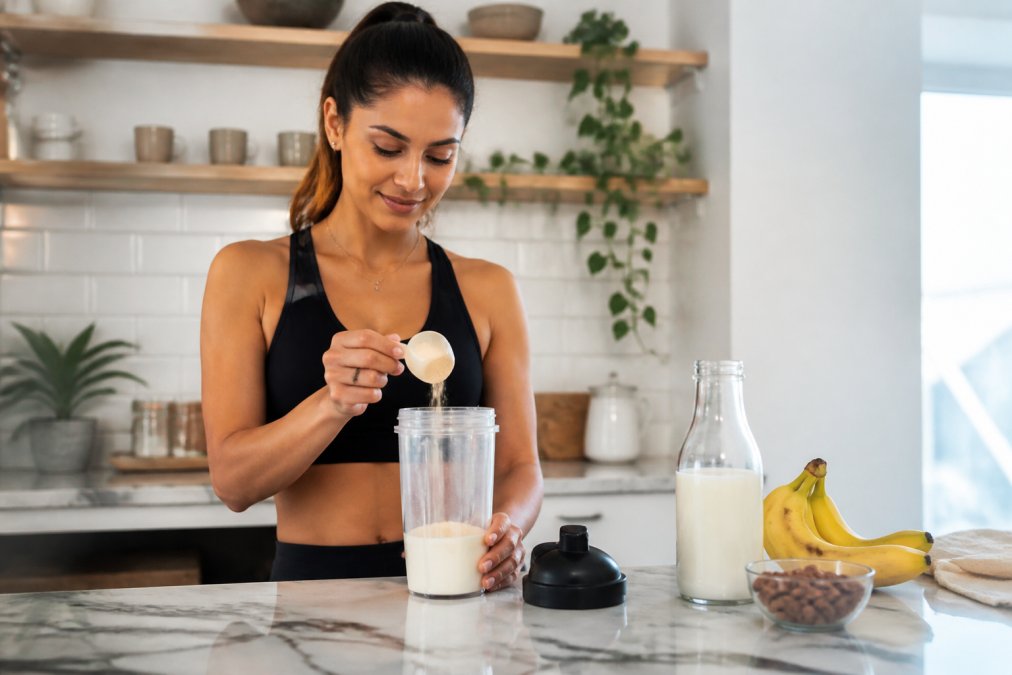
- Stage one: Add the powder to 2-4 ounces of room-temperature (roughly 68-75°F) liquid. Stir or swirl until the powder is fully wetted and no dry pockets remain. This takes about 20-30 seconds.
- Stage two: Add the rest of your cold liquid and ice, then shake or blend. Because the particles are already hydrated, the cold liquid chills the shake without re-creating dry cores.
Heat is a separate tool. Warm liquid (not boiling, boiling can denature and clump protein) hydrates plant powder faster than cold, which is why some people get a smoother result by mixing with warm water first and then chilling. The trade-off is that warm protein shakes can taste more beany, since heat volatilizes the earthy aroma compounds.
Hydration time: why two to three minutes matters
After mixing, wait two to three minutes before drinking. This is not superstition, it is the time insoluble fiber and starch need to fully absorb water and swell. A shake that tastes chalky at 30 seconds often tastes noticeably smoother at three minutes. If you have time, five minutes is even better for high-fiber blends.
Blender vs. shaker bottle
A blender does more than a shaker because the blades continue breaking down particles and the vortex forces liquid through the powder rather than around it. If you are serious about smoothness, this single change makes the biggest difference. A shaker bottle with a wire whisk ball is the next best option; a plain shaker with no agitator is the worst case for chalky powders.
Quick-reference fixes
- Start at 10-12 ounces of liquid per scoop, not the label's 6-8
- Use oat milk or soy milk for creaminess; water plus nut butter for a lower-calorie option
- Mix with 2-4 ounces of room-temperature liquid first, then add cold liquid and ice
- Let the shake rest 2-3 minutes before drinking
- Blend instead of shaking when texture is the priority
- Add a banana, frozen fruit, or a spoon of nut butter to improve viscosity and mouthfeel
Stack two or three of these and most plant proteins become genuinely enjoyable, not because the powder changed, but because the preparation finally matched what the ingredients need.
Vegan Protein Chocolate Shake - 1.5lb →
Protein Powder Flavor Masking Techniques That Work
Flavor masking is about covering earthy notes and beany flavors without adding sugar you don't want. Cocoa powder is the most effective single ingredient, which is why chocolate is the most forgiving plant protein flavor.
Fat is your second tool. A small amount of nut butter, avocado, or a plant-based milk with some fat content rounds off harsh notes and improves viscosity at the same time. Fat also slows the release of volatile flavor compounds, so the aftertaste fades faster.
Finally, salt. A tiny pinch of salt suppresses bitterness and makes sweet flavors read more clearly. It sounds counterintuitive for a sweet shake, but it works.
- Cocoa powder for earthy, beany notes
- Nut butter or avocado for harsh edges and thin texture
- A pinch of salt to cut bitterness
- Vanilla extract to round out the overall profile
- Frozen fruit to add natural sweetness and body
Stack two or three of these and most plant proteins become genuinely enjoyable.
Best Tasting Plant Protein Powder Reviews: What to Look For
When you're comparing plant proteins, texture should be your first filter, not flavor.
Look for isolate-based formulas with fine, uniform particle size. Check whether the ingredient list leans on whole-food ingredients or purified protein fractions, since that choice drives both texture and taste. A short, transparent ingredient list usually signals a cleaner formulation.
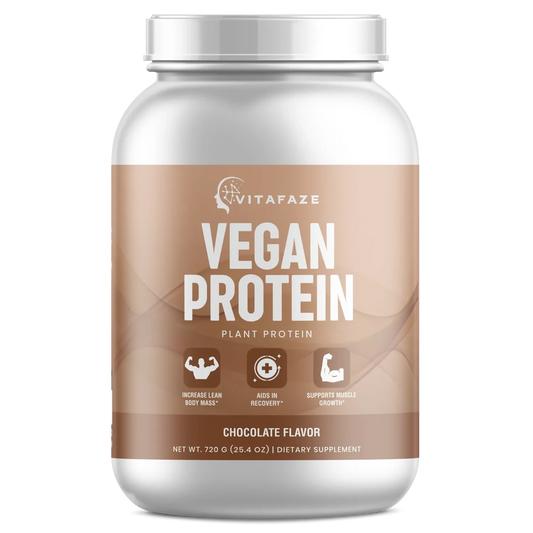
VitaFaze's Vegan Protein Chocolate Shake is built around this approach. It combines organic pea protein and organic brown rice protein for a complete amino acid profile, with 22 grams of protein per scoop. Organic cocoa powder and organic chocolate flavor carry the taste, while organic erythritol and organic stevia keep sugar at 3 grams per serving. Four grams of dietary fiber and organic acacia gum support digestion, and 155 mg of calcium rounds out the mineral profile.

For a thicker, meal-style option, the Essential Meal Replacement Protein delivers 24 grams of protein across seven protein sources, plus 5 grams of fiber and digestive enzymes for absorption. It comes in chocolate and vanilla milkshake flavors with zero added sugar.
If you want to compare texture across products, the practical test is simple: mix a single scoop in a clear glass with the same amount of water, wait two minutes, and look for settling. Fine sediment means fine particles. A layer of coarse grit at the bottom tells you the powder is milled too coarse for smooth drinking.
FDA guidance on dietary supplement labeling
Chalky plant protein isn't something you have to tolerate. Once you understand that particle size, fiber content, and hydration drive the texture, you can fix most shakes with more liquid, a blender, and a few minutes of patience.
At VitaFaze, we build plant-powered formulas with clean, bioavailable ingredients and fine, uniform milling so the texture matches the nutrition. Our Vegan Protein Chocolate Shake and Essential Meal Replacement Protein both deliver complete plant protein with the smoothness most powders miss. Get started with VitaFaze and make every shake one you actually look forward to drinking.
Frequently Asked Questions
Which plant-based protein powder doesn't taste chalky?
Protein powders made from pea protein isolate or a blend of pea and rice protein tend to have less chalkiness than single-source hemp or brown rice proteins. Look for products that use organic flavors and natural sweeteners like erythritol and stevia, and check reviews that specifically mention smooth texture. VitaFaze's Vegan Protein Chocolate Shake uses organic pea and brown rice protein with organic cocoa for a creamy consistency.
How to get rid of chalky taste in protein powder?
Start by adjusting your liquid-to-powder ratio: use 8-10 oz of liquid per scoop instead of the standard 6 oz. Blend instead of shaking to break up clumps. Add a healthy fat like almond butter or a frozen banana to coat your palate. You can also try mixing with oat milk or blending with ice for a thicker, smoother texture that masks any remaining chalkiness.
Does pea protein always have a chalky mouthfeel?
No. Pea protein isolate, which removes most fiber and starch, typically has a much smoother mouthfeel than pea protein concentrate. Chalkiness often comes from particle size and the presence of insoluble fibers. Choosing a product that uses fine-milled isolate and includes emulsifiers like acacia gum can significantly reduce that powdery sensation.
How can I improve the texture of my vegan protein shake?
Use a blender rather than a shaker bottle to fully break down powder particles. Add a tablespoon of nut butter or half an avocado for creaminess. Try blending with frozen fruit like mango or banana. Also, check the liquid temperature: cold liquids can make some proteins clump, so room-temperature liquid first, then ice, often yields a smoother result.