



Is Organic Plant Protein Powder Worth the Price?
Table of Contents
- What You Actually Pay For in Organic Plant Protein
- Organic vs Non-Organic Protein Powder: The Real Differences
- Is Plant Protein as Effective as Whey for Muscle Recovery?
- Cost Per Serving of Protein Powder: Running the Numbers
- Taste, Texture, and Mixability: Where Cheap Powders Fail
- Digestibility, Gut Health, and Bioavailability
- Heavy Metal Testing and Contaminant Screening Transparency
- Long-Term Budget Planning for Plant-Based Athletes
- Conclusion
- Frequently Asked Questions
Last Updated: September 23, 2026
What You Actually Pay For in Organic Plant Protein
Walk down any supplement aisle and you'll notice the price gap immediately. A tub of conventional plant protein might cost a third of what an organic version does, and the labels look nearly identical at a glance. So what justifies the difference? This guide from VitaFaze breaks down the real math behind organic plant protein, from certification costs to amino acid profiles, so you can decide whether the premium is worth it for your training and your budget.
The short answer: you're paying for three things. Certification and auditing, cleaner ingredient sourcing, and in the best cases, third-party testing that screens for heavy metals and contaminants. Whether those matter to you depends on how often you train and what you're willing to compromise on.
Certification Costs and What They Signal
USDA Organic certification isn't a marketing sticker. It requires annual inspections, documented sourcing, and strict limits on synthetic pesticides and fertilizers throughout the supply chain. Those audits cost money, and that cost gets passed to you.
What the label actually signals is traceability. A certified organic plant protein has to prove where its peas, rice, or hemp came from and how they were grown. Non-GMO verification works similarly, though it's a separate standard with its own verification process. Neither guarantees a better-tasting product, but both reduce your exposure to certain agricultural residues.
Organic vs Non-Organic Protein Powder: The Real Differences
The differences between organic and non-organic protein powder come down to three areas: pesticide residue limits, ingredient sourcing rules, and the additives a manufacturer is allowed to use. Organic standards restrict synthetic solvents and certain processing aids that conventional production can use freely.
That said, "non-organic" doesn't automatically mean "dirty." Many conventional plant proteins are still tested and still effective. The honest trade-off is this: organic reduces your exposure to a category of agricultural inputs, but you'll pay more for that peace of mind, and the protein itself may perform identically in your shake.
Where organic tends to pull ahead is in the additive list. Organic products are more likely to sweeten with stevia or monk fruit rather than artificial sweeteners, and less likely to include synthetic flavor masking agents. For people who read labels closely, that's the real selling point.
Is Plant Protein as Effective as Whey for Muscle Recovery?
For most recreational and competitive athletes, plant protein supports muscle recovery effectively when the total daily protein intake is adequate. The gap between plant and whey has narrowed considerably as blending technology has improved.
The catch is amino acid profile. Whey is naturally high in leucine, one of the branched-chain amino acids that triggers muscle protein synthesis. Individual plant sources like pea or rice are lower in certain essential amino acids, which is why quality plant proteins blend multiple sources together.
Amino Acid Profile and Protein Synthesis
A complete plant protein combines sources so the amino acid profile covers all nine essentials. Pea protein is rich in lysine but low in methionine. Brown rice protein is the reverse. Blend them, and you get a fuller profile than either delivers alone.
This is why single-source plant proteins often underperform in head-to-head comparisons. It's not that plants can't support protein synthesis. It's that one plant usually can't do it as completely as a blend. Look for a product that lists multiple protein sources on the label, and check whether it discloses its amino acid breakdown.
NIH overview of dietary protein and amino acid requirements
Cost Per Serving of Protein Powder: Running the Numbers
Cost per serving is the number most people calculate, and it's the least useful one. A serving might contain 20 grams of protein or 30, and the scoop size varies wildly between brands. Comparing raw serving costs across products tells you almost nothing about which one is actually cheaper to use.

Cost Per Gram of Protein vs Cost Per Serving
Cost per gram of protein is the metric that actually lets you compare products fairly. Divide the tub price by the total grams of protein it contains, and you get a number you can line up against any competitor, plant, whey, or otherwise.
The formula is simple: tub price ÷ (grams of protein per serving × number of servings per tub) = cost per gram of protein.
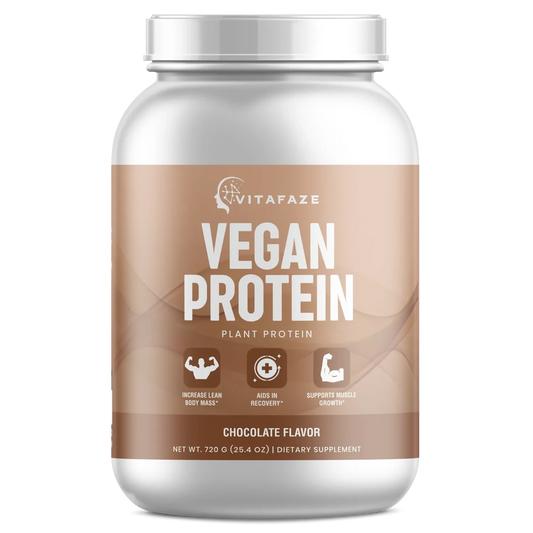
Here's how the math works in practice. VitaFaze's Vegan Protein Chocolate Shake delivers 22 grams of protein per scoop at $32.97 for a 1.5 lb tub. The Essential Meal Replacement Protein line, available in chocolate or vanilla, delivers 24 grams per serving at $33.32 for 2.9 lb. Run the division on total grams per container, and the larger tub usually wins on cost per gram even though the price tag looks similar.

| Metric | Vegan Protein Chocolate Shake | Essential Meal Replacement (Chocolate or Vanilla) |
|---|---|---|
| Price | $32.97 | $33.32 |
| Protein per serving | 22 g | 24 g |
| Tub size | 1.5 lb | 2.9 lb |
| Added sugar | 3 g | 0 g |
| Fiber per serving | 4 g | 5 g |
| Best for | Post-workout recovery | Meal replacement and daily nutrition |
Benchmarking Against Whey and Other Animal Proteins
This is the comparison most guides skip, and it's the one that decides whether the organic premium is defensible. Whey concentrate and whey isolate typically land in the same general cost-per-gram band as mid-tier plant proteins, and they carry a naturally higher leucine content. So on pure protein economics, organic plant protein rarely wins outright.
What shifts the math is what else you're buying. A conventional whey tub at a similar cost-per-gram doesn't include organic certification, doesn't screen the same way for agricultural residues, and isn't suitable if you're avoiding dairy. Once you price in a separate digestive enzyme supplement, a lactose-free alternative, or a cleaner-sweetener product to replace a whey tub you can't tolerate, the gap narrows considerably.
A useful rule of thumb: if organic plant protein lands within roughly 20-40% of your whey option on cost per gram, the certification and sourcing premiums are usually defensible for daily users. If it's double, you're paying for values more than nutrition, and that's a legitimate choice, just make it consciously.
The Monthly Cost Calculator
Annual and monthly cost is where the real decision lives. Work through this sequence:
- Count your actual monthly servings. Daily use is about 30; four training days a week is about 16-20; post-workout only is about 12.
- Multiply by cost per gram, not cost per serving. A 24 g scoop at $0.045/g costs about $1.08 per shake.
- Multiply by servings per month. Twenty shakes a month at $1.08 is roughly $21.60 monthly, or about $259 annually.
- Compare against the cheaper tub you'd actually finish. A budget powder you abandon after three weeks costs more per gram of protein consumed than a premium one you drink daily.
| Usage Pattern | Servings/Month | Approx. Monthly Cost at $1.08/Serving |
|---|---|---|
| Daily | 30 | ~$32 |
| 4x/week training | 16-20 | ~$17-$22 |
| Post-workout only | 12 | ~$13 |
The takeaway: a higher sticker price doesn't always mean a worse deal. A larger tub with more protein per serving often beats a cheaper one once you divide it out, and once you account for the tubs you actually finish. Do that math before you buy, not after.
Taste, Texture, and Mixability: Where Cheap Powders Fail
Cheap plant proteins cut corners in ways you notice on the first sip. Grittiness comes from coarse milling. Chalkiness comes from under-formulated blends. Flavor masking is where budget brands skimp most, because covering the earthy notes of pea and hemp protein takes real formulation work.
What most guides miss is that texture problems aren't just aesthetic. A powder you dread drinking is a powder you'll stop buying, which makes the "cheaper" option more expensive over a training cycle. Solubility matters too. A protein that clumps in a shaker wastes product and leaves you guessing at your actual intake.
If taste has been your barrier, look for products that use cocoa powder and organic flavor rather than relying on heavy sweetener loads. Natural sweeteners like stevia and monk fruit, used well, avoid the aftertaste that artificial sweeteners leave behind.
Digestibility, Gut Health, and Bioavailability
Digestibility separates a protein you can drink daily from one that leaves you bloated. Plant proteins vary widely here, and the differences come down to fiber content, added digestive enzymes, and how the protein was processed.
Bioavailability refers to how much of the protein your body can actually absorb and use. Some plant proteins score lower than animal sources on this measure, but blending and enzyme addition close much of the gap. A product with added digestive enzymes and prebiotic fiber supports absorption while keeping your gut comfortable.
Lactose-free is a given with plant protein, but that's not the whole story. Look for fiber sources like acacia gum, which feed gut bacteria without the gas that some fibers cause. If you've had trouble with plant proteins before, the culprit was likely the fiber blend or the protein source, not the category itself.
FDA guidance on dietary supplement labeling
Heavy Metal Testing and Contaminant Screening Transparency
Heavy metal testing is the transparency issue most brands avoid discussing, and it's the single clearest way to tell whether an organic premium is earning its keep. Plants absorb metals from soil, so rice, cocoa, and pea proteins can carry traces of cadmium, lead, arsenic, or mercury if sourcing isn't controlled. Third-party testing is what separates a brand that manages this from one that hopes you won't ask.
What a Certificate of Analysis Actually Contains
A certificate of analysis (COA) is the document a testing lab issues after running a batch through its panels. A useful COA lists the batch or lot number, the testing laboratory's name, the date of analysis, the specific contaminants screened, the method used, and the result against a stated limit. Without a lot number, a COA is just a marketing PDF, it can't be tied to the tub in your hand.
For plant proteins, the panels that matter most are:
- Heavy metals: lead, cadmium, arsenic, and mercury, usually reported in parts per billion or parts per million
- Microbiological: total plate count, yeast and mold, E. coli, and salmonella
- Residual solvents: relevant if the protein was processed with hexane or similar extraction aids
- Pesticide residues: particularly important for non-organic sources, and largely addressed by organic certification itself
Why Testing Justifies a Higher Price
Running a full contaminant panel on every batch is not cheap. A single comprehensive panel can run into the hundreds of dollars per lot, and a brand producing dozens of lots a year absorbs that as a recurring cost. That cost shows up in your tub price, and it's one of the few premiums that translates directly into a safer product rather than a nicer label.
Organic certification and heavy metal testing are complementary, not redundant. Organic rules govern how crops are grown and what inputs are allowed; they do not guarantee low heavy metal content, because metals occur naturally in soil. A brand can be certified organic and still source from a region with elevated cadmium. That's why the strongest products carry both: organic certification for the farming side, and independent contaminant testing for the finished product.
How to Request and Read Testing Results
Most reputable brands will provide a COA on request, either by email or through a lot-lookup tool on their site. When you get one, check three things: that the lot number matches your tub, that the lab is independent of the manufacturer, and that the reported values sit well below the limits rather than just under them. A result that barely passes is a different signal than one that comes in at a fraction of the threshold.
This is where the organic premium earns part of its keep. Organic sourcing rules limit certain inputs, the audit trail makes it harder to hide a problem supply chain, and published testing closes the loop. A brand that does all three is charging for verification, not for a sticker.
Long-Term Budget Planning for Plant-Based Athletes
Budget planning is where most athletes get it wrong. They compare per-tub prices and buy the cheapest option, then replace it three weeks later because they can't stand the taste. The real cost is what you spend over a training year, not what you spend at checkout.
A smarter approach: calculate your monthly protein needs first. If you train four times a week and use one shake per session, that's roughly 16 to 20 servings a month. Multiply that by your cost per gram, not your cost per serving. Then compare that annual figure against what you'd spend on a cheaper product you actually finish.
- Track your actual monthly servings, not your estimated ones
- Compare cost per gram of protein across the full tub, not the label price
- Factor in whether you'll finish the tub before it expires
- Weigh the cost of a product you'll drink consistently against a cheaper one you won't
The environmental angle deserves a mention too. Organic sourcing generally means fewer synthetic inputs, which many buyers weigh alongside price. That's a values calculation, not a performance one, and it's fine to let it tip your decision.
Conclusion
The organic premium isn't marketing fluff, but it isn't automatically worth it either. It buys you certification, cleaner sourcing, and better testing transparency, and those things matter more the harder you train and the more carefully you read labels. Run the cost-per-gram math, check the amino acid profile, and ask for testing results before you commit.
At VitaFaze, plant-powered nutrition is the whole point. Our formulas use clean, bioavailable ingredients to support muscle recovery, endurance, and cellular energy for athletes who won't compromise their values. The Vegan Protein Chocolate Shake and the Essential Meal Replacement line in chocolate or vanilla are built for exactly that. Shop all products and find the one that fits your training.

Frequently Asked Questions
Is organic plant-based protein powder actually better for you?
Organic certification means the ingredients meet USDA standards for growing and processing, which limits synthetic pesticide exposure. Whether it is better for you depends on your priorities. If you want to avoid trace pesticide residue and support farming practices with lower environmental impact, organic plant protein delivers that. If your main goal is hitting a protein target on a tight budget, conventional options can still work. The key is reading the label for protein content, added sugar, and third-party testing.
Does organic certification guarantee higher protein quality?
No. USDA Organic certification covers how ingredients are grown and processed, not the amino acid profile or protein density of the finished product. A certified organic powder can still have a poor amino acid profile if it relies on a single protein source. Look for blends that combine pea protein and brown rice protein to get a complete amino acid profile, and check that the label shows the actual grams of protein per serving.
How do you determine if a protein powder is worth the investment?
Start with cost per gram of protein, not cost per tub. Divide the total price by the total grams of protein in the container. Then factor in digestibility, taste, and whether the formula includes extras like digestive enzymes or fiber. A powder that costs more per serving but mixes well, tastes good, and absorbs efficiently may deliver better value than a cheaper option you dread drinking.
What should you look for on a protein powder label to ensure value?
Check four things: grams of protein per serving, the full amino acid profile or protein sources listed, added sugar content, and whether the brand publishes third-party testing results for heavy metals. A short ingredient list with recognizable protein sources and no artificial sweeteners is a good sign. If the label lists a proprietary blend without amounts, you cannot verify what you are paying for.
These statements have not been evaluated by the Food and Drug Administration. This product is not intended to diagnose, treat, cure or prevent any disease.